Handwashing stations are required on construction sites where workers apply paints, coatings, herbicides or insecticides, under OSHA 1926.51(f)(1). Standard job sites still need potable water under OSHA 1926.51(a)(1), and any wash station needs soap and towels under 29 CFR 1910.141(d)(2), not just sanitizer. Sioux Falls contractors ask us this every week.
Two separate rules cover this, and people mix them up constantly. OSHA 1926.51(f)(1) is the paint and chemical rule. If your crew is spraying coatings, herbicides or insecticides, or working around other harmful contaminants, you need washing facilities on site, full stop. That is different from general sanitation. OSHA 1926.51(c) governs toilet counts on construction sites, not handwashing directly, but the two usually get planned together because crews use both at the same station area. Separately, 29 CFR 1910.141(d)(2) says washing facilities need soap and towels or a hand-drying device. Hand sanitizer alone does not satisfy that rule. We get calls from Sioux Falls project managers who assumed a sanitizer stand covered them. It doesn't. If your scope involves any temporary fence rental job with painting work mixed in, or a construction site services package with coating subs on site, build the wash station into your plan from day one, not as an afterthought once someone fails an inspection.
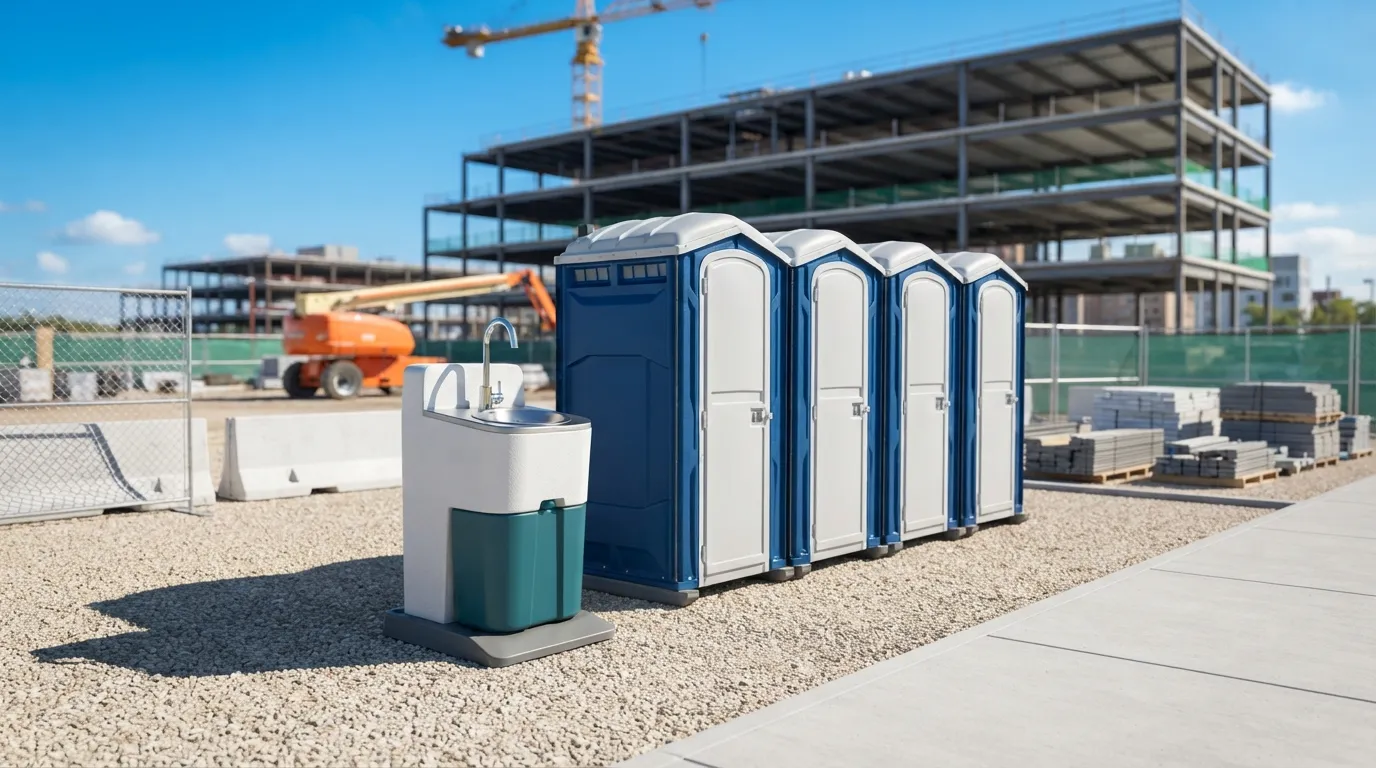
Put them next to the toilets, not across the lot. Most crews cluster a handwashing station rental unit right beside their standard porta potty rental bank, because workers use both in the same trip and it cuts down on wasted time. If you're running an ADA-compliant setup, ADA Standards section 213.2 requires that where single-user toilets are clustered, at least 5 percent of the units, and never fewer than one, must be accessible, so your ADA accessible porta potty needs a matching accessible path to the wash station too. That path has to meet a few other specs while we're at it: ADA Standards section 403.5.1 sets a 36 inch minimum clear width for the route, and section 405.2 caps ramp slope at 1:12 if the ground isn't level. Sioux Falls sites near downtown or on tighter urban lots feel that width requirement fast. If you're staging near Harrisburg, 8.6 miles south, or out toward Tea, 9.7 miles southwest, you've usually got more room to work with, but the same rules apply regardless of lot size.
No. A porta potty is a toilet, not a wash station, even the deluxe flushable porta potty models with a built-in sink reservoir. Those built-in sinks help, and they're a nice step up from a bare-bones unit, but a dedicated portable sink rental or freestanding handwashing unit is what satisfies 29 CFR 1910.141(d)(2) on paper. Inspectors look for soap and a towel or drying device at the station, not just a spigot. If your crew is doing any spray work, herbicide application, or handling coatings, the requirement gets stricter under OSHA 1926.51(f)(1), and a plain hand sanitizer station rental won't cover that gap either. Sanitizer is a fine supplement. It is not a substitute. We tell every Sioux Falls contractor the same thing: budget for a real wash station with running water, soap and towels if paint or chemicals are anywhere in the scope, and pair it with your portable toilet rental order so delivery happens in one trip.
There's no fixed OSHA ratio published for handwashing units the way there is for toilets. OSHA 1926.51(c)(1) sets toilet counts at 1 facility for 20 workers or fewer, then scales up from there as headcount grows, and most crews plan wash stations at a similar density, one station per toilet cluster. Field work outside construction follows a different rule. OSHA 1928.110 covers agricultural hand-labor crews and requires one facility per 20 employees, reachable within a quarter mile walk, water and handwashing included. If you're running a farm and agricultural restrooms setup near Brandon, 10.3 miles northeast, or Renner Corner, 8.5 miles north, that quarter-mile rule matters more than the construction ratio does. For general industry workplaces that aren't construction sites, 1910.141(c)(1)(i) sets its own toilet ratios by employee count. Match your wash station order to whichever standard actually governs your site, not the one that's easiest to remember.
Pricing depends on unit type and rental length, and we quote it against our own measured range rather than a flat number. Ask us for a request a quote breakdown once we know your headcount and duration, and check the porta potty rental cost page for how toilet and wash station pricing usually bundle together.
No. 29 CFR 1910.141(d)(2) specifically requires soap and towels or a hand-drying device at washing facilities. Sanitizer can supplement a station, but it does not replace running water, soap and drying capability. Sioux Falls sites that rely only on sanitizer stands are not meeting this standard.
You still need potable water under OSHA 1926.51(a)(1) on most construction sites. The stricter paint and chemical rule, 1926.51(f)(1), only kicks in with coatings, herbicides or insecticides. General crews still benefit from a wash station paired with their porta john rental order.
That placement needs confirming with the City of Sioux Falls before delivery. We don't guess on right-of-way rules, so check with the city directly or ask us and we'll help you sort out where placement is allowed.
There's no fixed distance in the construction rules, but agricultural field work under OSHA 1928.110 requires facilities within a quarter mile walk. Most Sioux Falls job sites place wash stations right next to the toilet cluster for convenience.
Not much in practice. Both terms describe a self-contained unit with water, soap and towels. See our portable sink rental page for specifics, or pair one with a restroom trailer rental for larger events.
Yes. Sioux Falls Porta Pros delivers handwashing station requirements across Sioux Falls and the surrounding metro, with same-day and next-day drop-off available on most orders.
Pricing depends on the unit and how long you need it. See our cost breakdown and request a free quote for an exact figure.
Standard rentals include scheduled service — a pump-out, a clean, a restock and fresh deodorizer. Busy or hot-weather sites can be serviced more often.
Call now or request a free quote — clean units, on-time delivery, transparent pricing.